Conscious Menopause Part II
Published in the August 2023 edition of ‘The Bay’ Magazine

Conscious Menopause Part II – printer friendly, text version
Whether you are starting to notice the first signs of perimenopause, or your menstrual cycle has ceased there are lots of ways to help shift your body back into balance.
Giving yourself the time and space to readjust whilst tackling any underlying health conditions is the key to a positive menopause, but herbs that ease menopausal symptoms are also a great help.
Phytoestrogens
Meaning simply ‘plant oestrogens’, these plant compounds have a structural similarity to estradiol – the most potent female sex hormone. When oestrogen levels are low phytoestrogens mimic its action, having a milder effect but helping to reduce symptoms of oestrogen decline.
Research has found that a high phyoestrogen intake is linked to reduced hot flushes, improved cognitive function, reduced breast cancer risk as well as benefiting skin health.
It’s not only women who benefit from a regular dose of these plant hormones. A recent large-scale study that spanned over 30 years, followed over 100,000 men and women, regularly assessing their phytoestrogen intake. It found that the highest intake of phytoestrogens was significantly associated with lower cardiovascular disease deaths as well as an 11% lower risk of death from any disease1.
Good food sources of phytoestrogens include flax seeds, tempeh, miso, broccoli, alfalfa sprouts, lentils and whole grains. Soy products can be challenging to digest so look for minimally processed or fermented products.
Phytoestrogenic Herbs
In addition to eating a diet rich in plants and whole foods, certain herbs are particularly high in phytoestrogens and can be included in the diet in the form of medicinal teas or tinctures.
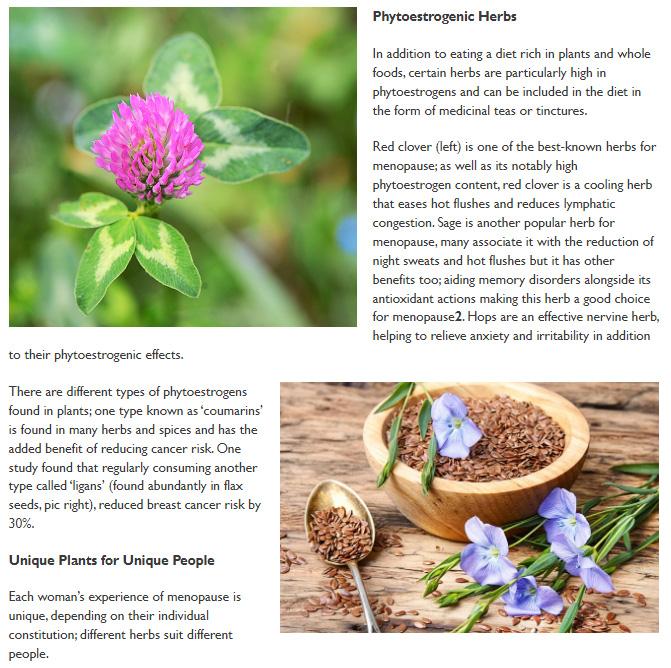
Red clover is one of the best known herbs for menopause; as well as its notably high phytoestrogen content, red clover is a cooling herb that eases hot flushes and reduces lymphatic congestion. Sage is another popular herb for menopause, many associate it with the reduction of night sweats and hot flushes but it has other benefits too; aiding memory disorders alongside its antioxidant actions making this herb a good choice for menopause2. Hops are an effective nervine herb, helping to relieve anxiety and irritability in addition to their phytoestrogenic effects.
There are different types of phytoestrogens found in plants; one type known as ‘coumarins’ is found in many herbs and spices and has the added benefit of reducing cancer risk. One study found that regularly consuming another type called ‘ligans’ (found abundantly in flax seeds), reduced breast cancer risk by 30%
Unique Plants for Unique People
Each woman’s experience of menopause is unique, depending on their individual constitution; different herbs suit different people.
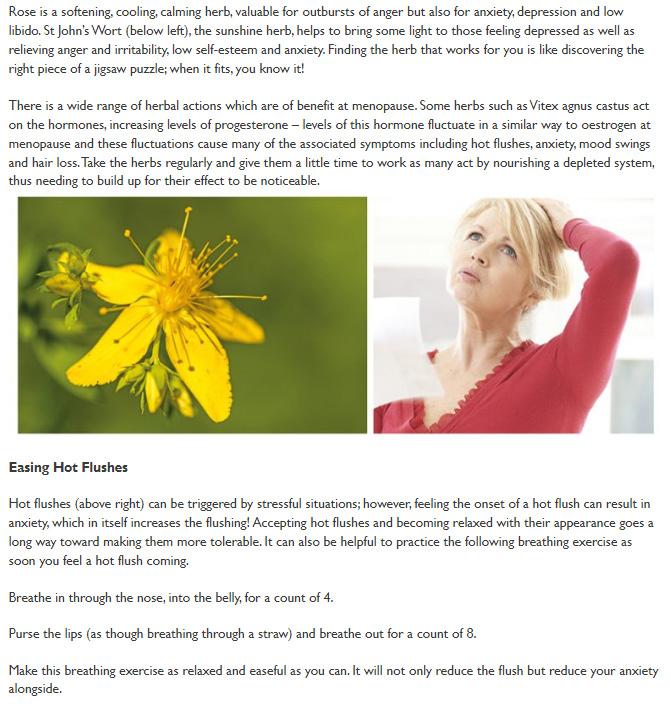
Rose is a softening, cooling, calming herb, valuable for outbursts of anger but also for anxiety, depression and low libido. St John’s Wort, the sunshine herb, helps to bring some light to those feeling depressed as well as relieving anger and irritability, low self esteem and anxiety. Finding the herb that works for you is like discovering the right piece of a jigsaw puzzle; when it fits, you know it!
There is a wide range of herbal actions which are of benefit at menopause. Some herbs such as Vitex agnus castus act on the hormones, increasing levels of progesterone – levels of this hormone fluctuate in a similar way to oestrogen at menopause and these fluctuations cause many of the associated symptoms including hot flushes, anxiety, mood swings and hair loss. Take the herbs regularly and give them a little time to work as many act by nourishing a depleted system, thus needing to build up for their effect to be noticeable.
Easing Hot Flushes
Hot flushes can be triggered by stressful situations; however, feeling the onset of a hot flush can result in anxiety, which in itself increases the flushing! Accepting hot flushes and becoming relaxed with their appearance goes a long way toward making them more tolerable. It can also be helpful to practice the following breathing exercise as soon you feel a hot flush coming.
- Breathe in through the nose, into the belly, for a count of 4.
- Purse the lips (as though breathing through a straw) and breathe out for a count of 8.
Make this breathing exercise as relaxed and easeful as you can. It will not only reduce the flush but reduce your anxiety alongside.
- Zhangling Chen et al. Dietary Phytoestrogens and Total and Cause-Specific Mortality: Results From Two Prospective Cohort Studies. Current Developments in Nutrition; Volume 6, Supplement 1, June 2022, Page 890
- S Bommer et al. First time proof of sage’s tolerability and efficacy in menopausal women with hot flushes. Adv Ther. 2011 Jun;28(6):490-500.
- The ‘Herbal Clinic’ in Swansea provides natural medicine healthcare with the use of organic herbs, acupuncture and iridology.

This Post Has 0 Comments