
Rekindle Your Digestive Fire
Published in the February 2020 edition of ‘The Bay’ Magazine
Rekindle Your Digestive Fire: printer friendly, text version
Large meals, rich foods and a string of festive parties usually mean that by now your body is ready for a seasonal clearout. It’s natural to feel drawn to lighter, simpler foods after a period of feasting; however, if a lack of appetite or sluggish digestion persists, you may need to pay some extra attention to your digestive organs and rekindle your digestive fire.
Building the Fire
A strong digestive fire is apparent when there is a healthy appetite for wholesome foods, there is no discomfort after eating and the bowels move regularly and with ease. This is a sign that the digestive organs are responsive and digestive secretions are plentiful. Circulation of blood to the gut is free flowing allowing all the nutrients to be absorbed and distributed. If there is inadequate production of digestive juices by the stomach and pancreas there may be bloating, discomfort after meals or a sense of fullness that continues for some time after eating.
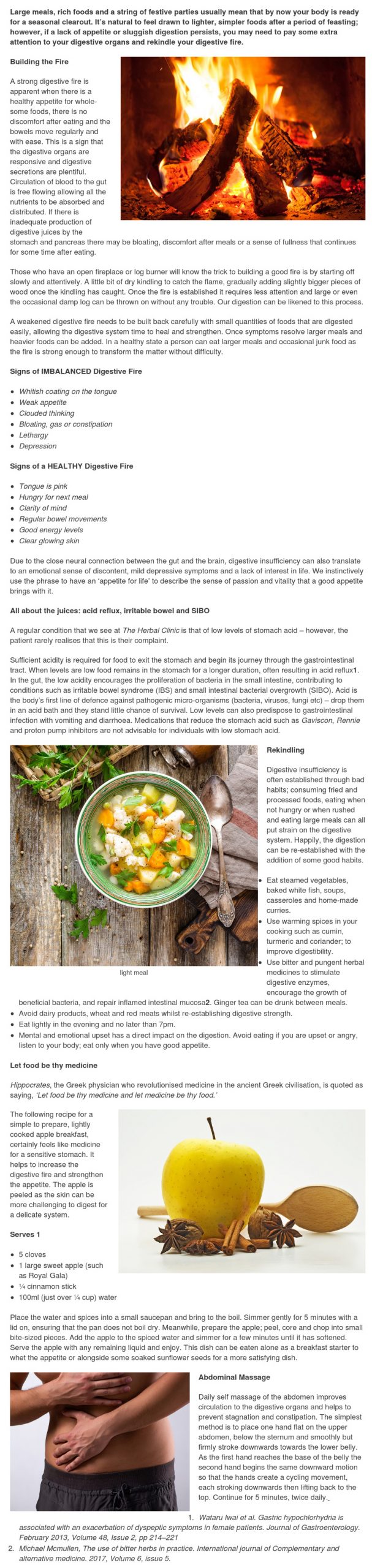
Those who have an open fireplace or log burner will know the trick to building a good fire is by starting off slowly and attentively. A little bit of dry kindling to catch the flame, gradually adding slightly bigger pieces of wood once the kindling has caught. Once the fire is established it requires less attention and large or even the occasional damp log can be thrown on without any trouble. Our digestion can be likened to this process.
A weakened digestive fire needs to be built back carefully with small quantities of foods that are digested easily, allowing the digestive system time to heal and strengthen. Once symptoms resolve larger meals and heavier foods can be added . In a healthy state a person can eat larger meals and occasional junk food as the fire is strong enough to transform the matter without difficulty.
Signs of Imbalanced Digestive Fire
Whitish coating on the tongue
Weak appetite
Clouded thinking
Bloating, gas or constipation
Lethargy
Depression
Signs of a Healthy Digestive Fire
Tongue is pink
Hungry for next meal
Clarity of mind and regular bowel movements
Good energy levels
Clear glowing skin
Due to the close neural connection between the gut and the brain, digestive insufficiency can also translate to an emotional sense of discontent, mild depressive symptoms and a lack of interest in life. We instinctively use the phrase to have an ‘appetite for life’ to describe the sense of passion and vitality that a good appetite brings with it.
All about the juices: acid reflux, irritable bowel and SIBO
A regular condition that we see at The Herbal Clinic is that of low levels of stomach acid – however, the patient rarely realises that this is their complaint.
Sufficient acidity is required for food to exit the stomach and begin its journey through the gastrointestinal tract. When levels are low food remains in the stomach for a longer duration, often resulting in acid reflux1. In the gut, the low acidity encourages the proliferation of bacteria in the small intestine, contributing to conditions such as irritable bowel syndrome (IBS) and small intestinal bacterial overgrowth (SIBO). Acid is the body’s first line of defence against pathogenic micro-organisms (bacteria, viruses, fungi etc) – drop them in an acid bath and they stand little chance of survival. Low levels can also predispose to gastrointestinal infection with vomiting and diarrhoea. Medications that reduce the stomach acid such as Gaviscon, Rennie and proton pump inhibitors are not advisable for individuals with low stomach acid.
Rekindling
Digestive insufficiency is often established through bad habits; consuming fried and processed foods, eating when not hungry or when rushed and eating large meals can all put strain on the digestive system. Happily, the digestion can be re-established with the addition of some good habits.
- Eat steamed vegetables, baked white fish, soups, casseroles and home-made curries.
- Use warming spices in your cooking such as cumin, turmeric and coriander; to improve digestibility.
- Use bitter and pungent herbal medicines to stimulate digestive enzymes, encourage the growth of beneficial bacteria, and repair inflamed intestinal mucosa2. Ginger tea can be drunk between meals.
- Avoid dairy products, wheat and red meats whilst re-establishing digestive strength.
- Eat lightly in the evening and no later than 7pm.
- Mental and emotional upset has a direct impact on the digestion. Avoid eating if you are upset or angry, listen to your body; eat only when you have good appetite.
Let food be thy medicine
Hippocrates, the Greek physician who revolutionised medicine in the ancient Greek civilisation, is quoted as saying, ‘Let food be thy medicine and let medicine be thy food.’
The following recipe for a simple to prepare, lightly cooked apple breakfast, certainly feels like medicine for a sensitive stomach. It helps to increase the digestive fire and strengthen the appetite. The apple is peeled as the skin can be more challenging to digest for a delicate system.
Serves 1.
5 cloves
1 large sweet apple (such as Royal Gala)
¼ cinnamon stick
100ml (just over ¼ cup) water.
Place the water and spices into a small saucepan and bring to the boil. Simmer gently for 5 minutes with a lid on, ensuring that the pan does not boil dry. Meanwhile, prepare the apple; peel, core and chop into small bite-sized pieces. Add the apple to the spiced water and simmer for a few minutes until it has softened. Serve the apple with any remaining liquid and enjoy. This dish can be eaten alone as a breakfast starter to whet the appetite or alongside some soaked sunflower seeds for a more satisfying dish.
Abdominal Massage
Daily self massage of the abdomen improves circulation to the digestive organs and helps to prevent stagnation and constipation. The simplest method is to place one hand flat on the upper abdomen, below the sternum and smoothly but firmly stroke downwards towards the lower belly. As the first hand reaches the base of the belly the second hand begins the same downward motion so that the hands create a cycling movement, each stroking downwards then lifting back to the top. Continue for 5 minutes, twice daily.
The ‘Herbal Clinic’ in Swansea provides natural healthcare with the use of organic herbs, acupuncture and iridology.

This Post Has 0 Comments